Flying boats and seaplanes on a shelf
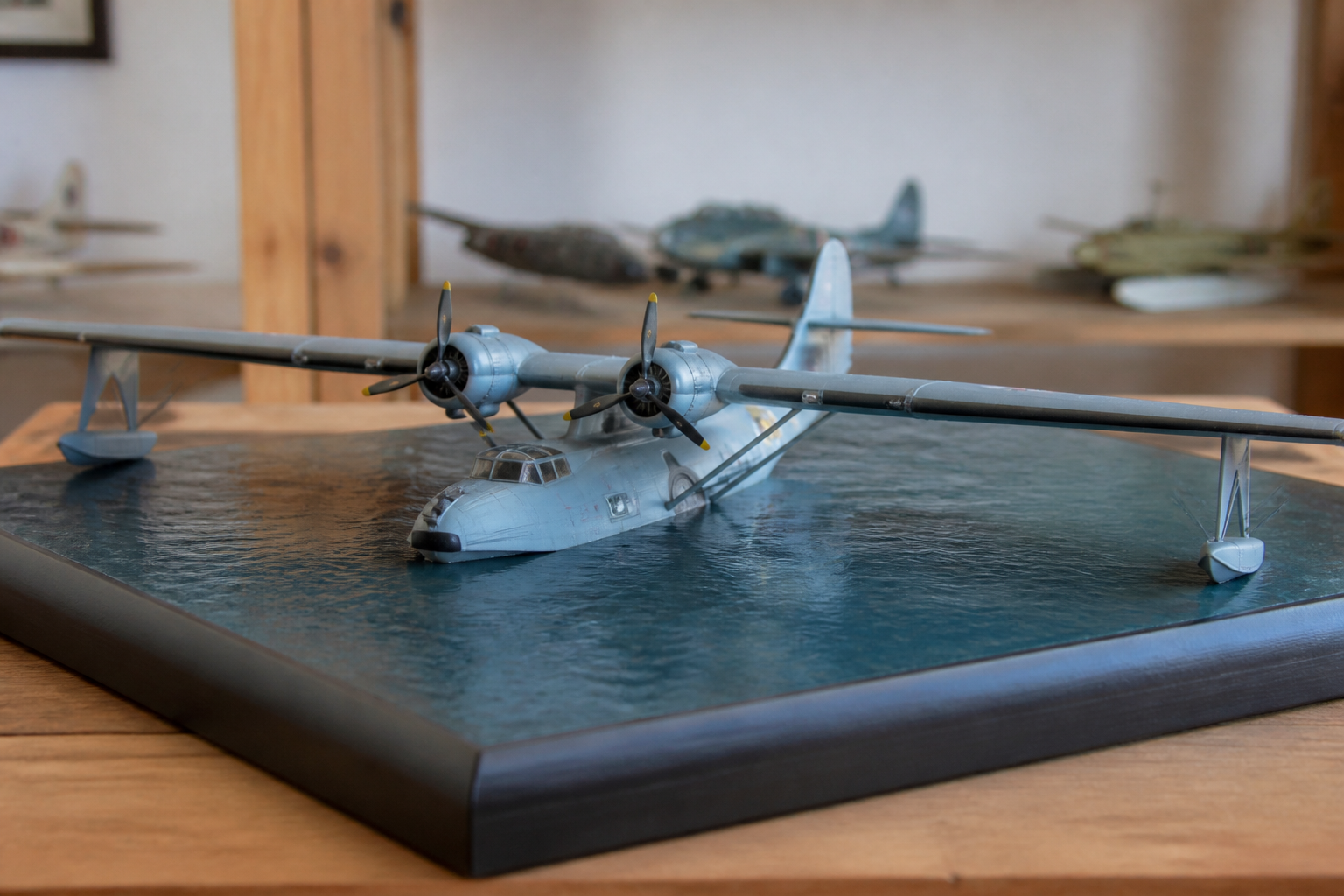
A hull-borne aircraft forces a decision no landplane model does. It has a waterline, and you have to decide whether to show it.
- Last reviewed 20/08/2026
- Subject room
- Hull and float aircraft
- Usual scales
- 1/72 for kits, 1/144 for the largest hulls
- The decision
- Beached, on water, or in flight
- Hardest step
- Float and strut alignment
- Main pitfall
- A hull with a twist you only notice after painting
Flying boats and floatplanes are the most rewarding aircraft models to display and the least forgiving to assemble. The reward is that a hull gives you a context no landplane has. The difficulty is that everything hangs off struts, and struts have to be right in three axes at once.
Three ways to display a hull
| Mode | What it needs | What it shows | What it costs |
|---|---|---|---|
| Beached, on trolley or gear | A flat surface and the beaching gear from the kit or scratch | The whole hull, including the step and the keel | Looks like maintenance rather than flight |
| On a water base | A board, a waterline decision, and a sealed hull | The aircraft as it was used, at rest or taxiing | Doubles the footprint and hides the lower hull |
| In flight, on a rod | A drilled mounting point and a base heavy enough not to tip | The underside, the hull lines and the float struts | Commits the model to one attitude for good |
Most collections end up with one of each, because the three modes look different enough that they do not compete for attention on the same shelf.
Alignment is the whole game
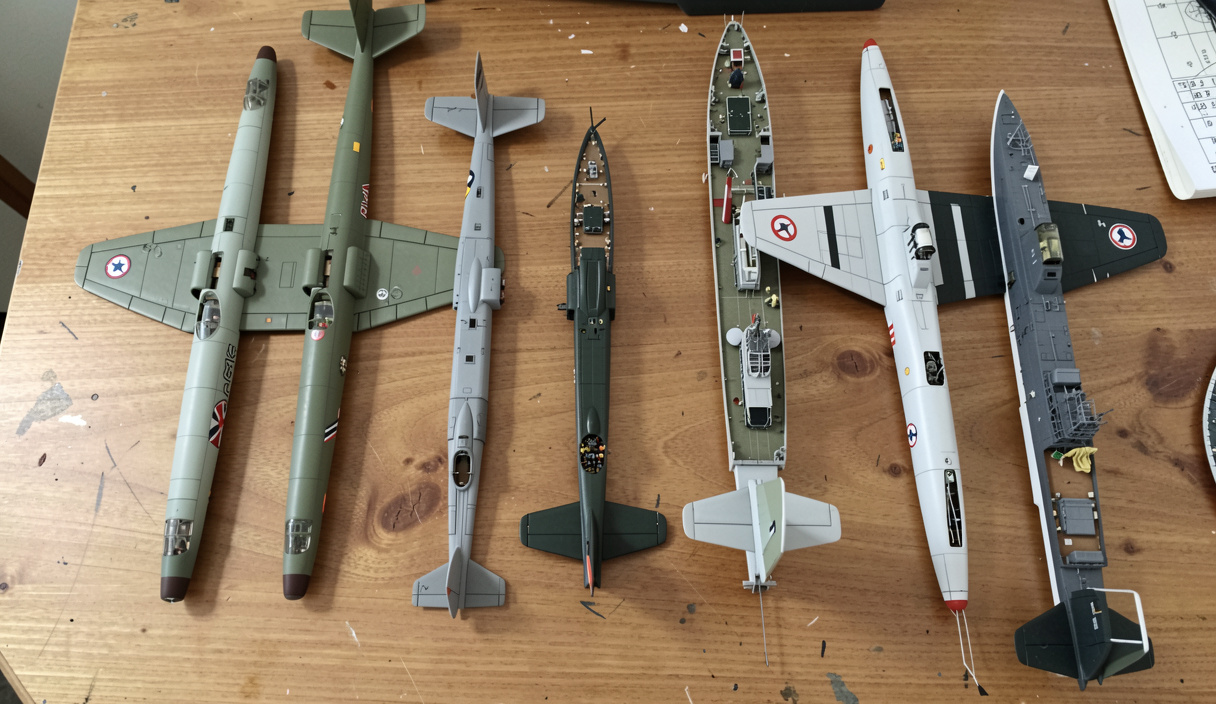
Wingtip floats, sponsons and engine nacelles all sit on struts, and a strut glued a millimetre out at the root is several millimetres out at the tip. The method that works is unglamorous:
- Dry fit everything before any cement touches a joint. If a strut does not sit in its locating hole under its own weight, open the hole rather than forcing the strut.
- Build a jig from a flat board and two blocks of scrap. The hull sits between the blocks, so it cannot rock while glue sets.
- Glue one strut at a time, and check after each one from directly in front at eye level, then from directly above. Those two views catch every alignment error there is.
- Let each joint cure fully. Liquid cement is soft for far longer than it feels, and a joint tweaked at the wrong moment stays tweaked.
The same discipline applies to biplane and rigged aircraft, where it matters even more. See the early aviation page for the rigging order that makes it survivable.
Chines, spray rails and the planing step
A flying boat hull is a boat first. Three features do the work, and a kit that moulds them crisply is worth more than a kit with extra rivets:
- The planing step, the sharp break in the underside partway along the hull, which lets the aircraft unstick from the water.
- The chine, the hard edge where the bottom of the hull meets the side. It should stay a crisp line all the way forward, and it is the first casualty of over-enthusiastic sanding.
- The spray rails, thin strips along the forward chine that throw water down and away from the propellers.
When you sand a hull seam, sand across the chine as little as possible, and restore the edge with a sanding stick used flat against the hull side rather than rolled around it.
These aircraft are bigger than people expect
| Type | Span | 1/72 | 1/144 |
|---|---|---|---|
| Supermarine Walrus | 13.97 m | 19.4 cm | 9.7 cm |
| Grumman G-21 Goose | 14.94 m | 20.8 cm | 10.4 cm |
| Dornier Do 24 | 27.00 m | 37.5 cm | 18.8 cm |
| Consolidated PBY-5A Catalina | 31.70 m | 44.0 cm | 22.0 cm |
| Short Sunderland Mk III | 34.39 m | 47.8 cm | 23.9 cm |
| Martin PBM Mariner | 35.97 m | 50.0 cm | 25.0 cm |
A Sunderland at 1/72 is half a metre across and, on a water base, needs a board wider still. This is the one branch of aircraft modelling where 1/144 is a serious option rather than a compromise, because the shapes are large enough to read even when small.
Water bases without the mess
Three approaches, in order of difficulty:
- Painted board. Hardboard or MDF, sealed, painted in three or four blended tones, then given several coats of gloss varnish. Cheap, flat, and convincing at normal viewing distance.
- Glass with painted underside. A sheet of glass over a painted board. The depth of the glass gives real translucency, and the surface is genuinely smooth.
- Acrylic gel medium. Clear gel, textured with a stiff brush while wet, then tinted and varnished. The only method that gives real relief, and the only one where restraint matters: scale waves are much smaller than instinct suggests.
Whatever the method, keep the water low. A hull sits in water, not on it, and the most common mistake is a wave height that would be three metres at full size.
Before you cut the hull to a waterline
A waterline model cannot be shown beached, and the cut cannot be undone. If you are unsure, build the full hull and set it into a base with a recess instead. You keep both options, and the join at the waterline is easier to disguise than a bad cut.
Weathering a hull that lives in salt
Salt water leaves specific marks and only those marks. A scum line at the waterline, slightly ragged and darker on the shadowed side. Bright scuffing along the chine and around the step, where beaching gear and slipways rub. Exhaust staining behind the engines, running back over the wing rather than the hull. Restraint is the whole technique: three subtle effects read as a working aircraft, while six read as a wreck.
- Waterline model
- A model cut off at the level the hull would sit in water, so it can only be shown floating.
- Planing step
- The transverse break in a hull bottom that lets the aircraft break free of the water on take-off.
- Sponson
- A stub wing or fairing on the hull side that gives stability on the water. Dornier types are the obvious example.
- Beaching gear
- Removable wheels clamped to a flying boat hull so it can be pulled up a slipway. The reason a beached model looks convincing.
A hull-borne aircraft forces a decision no landplane model does. It has a waterline, and you have to decide whether to show it. That decision is the same one a clock collector faces when a case and a movement disagree about their date: the evidence sits in the object, and the reading takes patience. The bench notes on dating an antique clock set out checks a buyer can repeat, from movement signatures to case wear, and the method transfers to any object with layers. Both pages share one habit: measure first, then commit to the finish.
A hull-borne aircraft forces a decision no landplane model does. It has a waterline, and you have to decide whether to show it. That choice, like the choice of a beaching trolley or a water base, is about how a shape reads when it is printed on a surface, and the same question runs through vintage Halloween printed imagery, where Samhain, carved pumpkins and the holiday's origins are read from the pictures that carried them. Both pages treat a silhouette as evidence: one asks where the water sits on a hull, the other asks what a lantern was meant to say.
A waterline also decides how the model is lit, since a beached hull reads differently from one sitting on a painted base. Builders who want the water itself to look right often end up studying how light behaves on a shoreline, which is the same problem tackled in painting outdoors on the bay, a set of notes on how painters, potters and woodworkers on the Anne Arundel shore plan a season around tides, local clay, firing logs and field notebooks. The concerns overlap: weather, timing, and a surface that changes hour by hour.
Where to go from here
- The rigging order that keeps struts straight
Float struts and biplane rigging fail the same way. The sequence on that page prevents both.
- Give a water base the space it needs
A base doubles the footprint. Plan the shelf around the largest model, not the average one.
- Why 1/144 is a real option for big hulls
The scale ladder, with spans worked out, so the choice is a measurement rather than a guess.