Best display case for model planes
Four case families cover almost every collection. The real decision is acrylic against glass, and how much dust you are prepared to live with.
- Last reviewed 20/08/2026
- Guide
- Cases and cabinets
- Families
- Four
- Material
- Acrylic or glass
- Sizing rule
- Wingspan plus twenty per cent
- Never use
- Ammonia cleaner on acrylic
A case does three jobs: it keeps dust off, it stops hands touching, and it turns a model into an object worth looking at. Most people buy for the third and are disappointed by the first, because the joints leak.
The four families
| Family | Holds | Best for | Weakness |
|---|---|---|---|
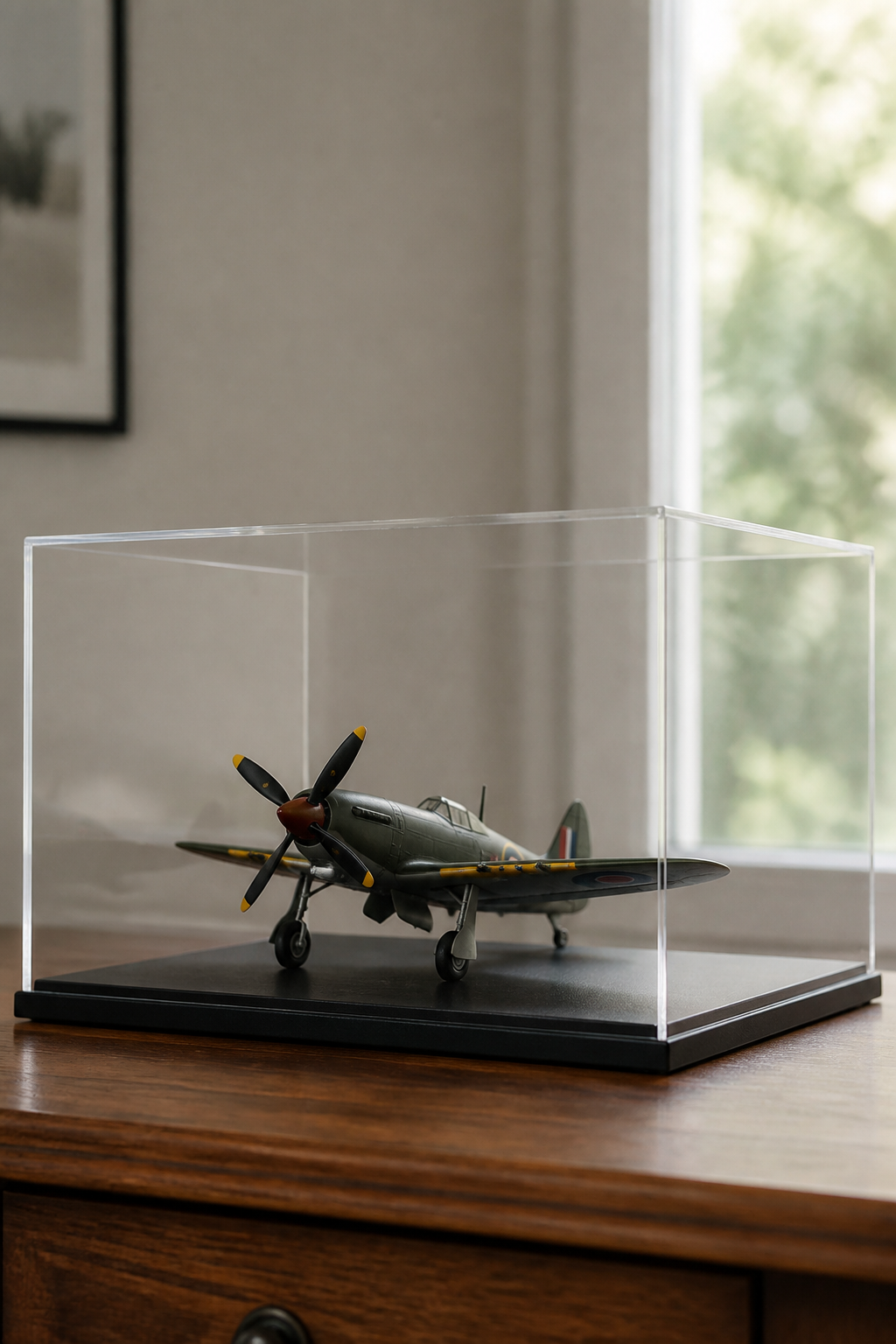
| Tabletop box, lid over a plinth | One to three models | A single model that deserves it | Cost per model is the highest of the four |
| Wall-mounted shadow box | One model, shallow | In-flight mounts and small scales | Depth is limited, so wingspan is limited |
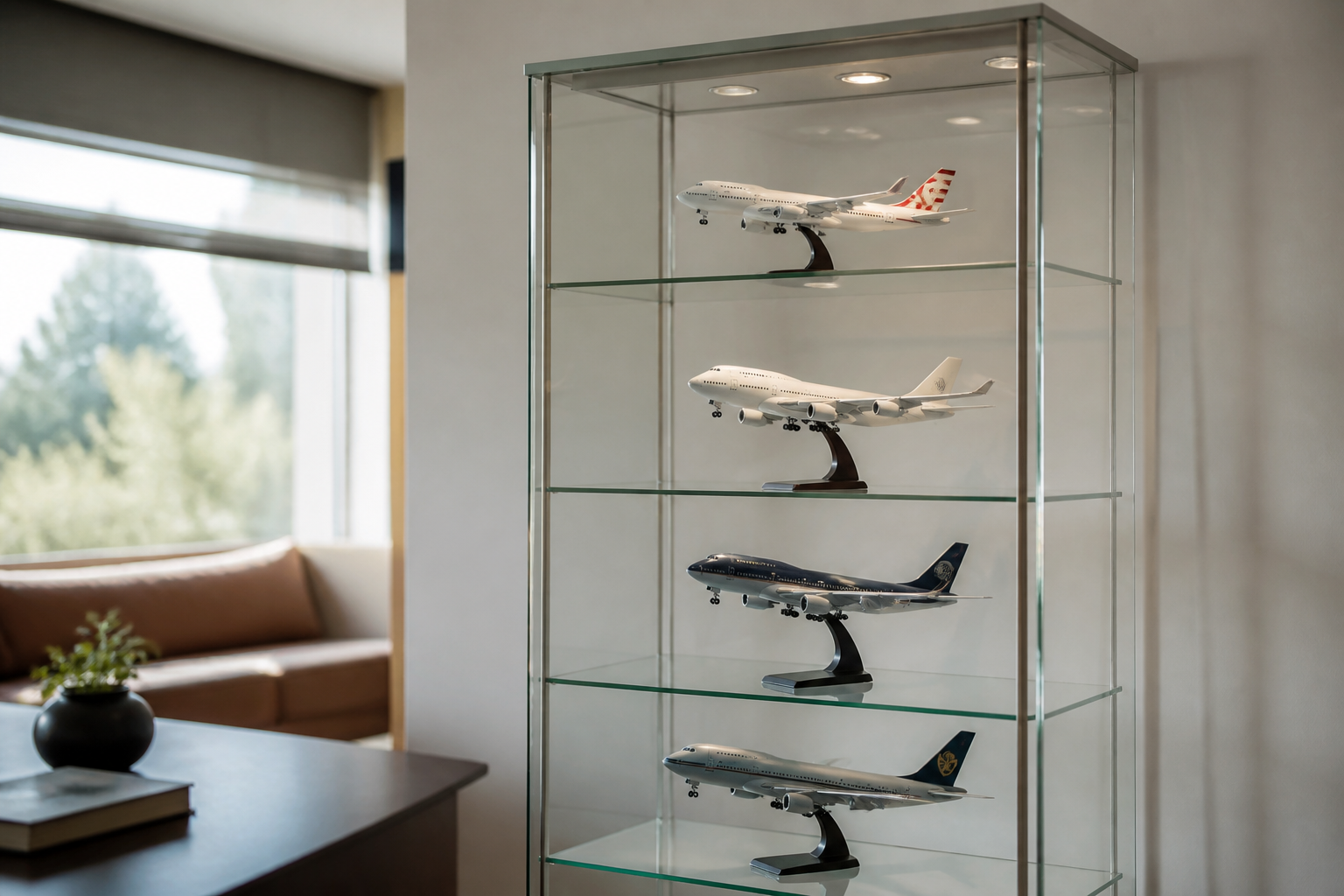
| Tall cabinet with glass shelves | A whole collection | Growing collections, mixed scales | Doors seal badly unless the seal is specified |
| Purpose-built cabinet | Whatever you specify | Large models, rigged models, ships | Cost and lead time |
Acrylic against glass
| Property | Acrylic | Glass |
|---|---|---|
| Weight | Roughly half that of glass for the same panel | Heavy; large panels need real support |
| Optical clarity | Very high when new | High and stable over decades |
| Scratching | Scratches easily, but light scratches polish out | Hard to scratch, impossible to polish out |
| Static | Attracts dust to the inside face | Neutral |
| Yellowing | Cast acrylic is stable; cheap extruded sheet can yellow | Does not yellow |
| If it fails | Cracks, does not shower the model in fragments | Can shatter |
| Cleaning | Mild soap or anti-static plastic cleaner only | Ordinary glass cleaner |
For a case that will be moved, or hung on a wall, or that contains a model you would rather not have glass fall onto, acrylic is the sensible answer. For a cabinet that will stand in one place for twenty years and be cleaned regularly, glass is better and ages better.
Sizing: the two measurements people get wrong
Width. Wingspan plus about twenty per cent. The extra is not decoration: you need room to get fingers on the fuselage and lift the model out without the wingtips touching the walls. A case sized exactly to the span is a case you will eventually break the model getting into.
Height. Measure the tallest point as displayed, which may be a fin, a rotor head, a mast or the top of an in-flight rod, and add three or four centimetres. On ship models the masts almost always decide the height, and they are almost always underestimated.
Depth is the fuselage length for a model displayed square on, but the wingspan again if the model sits at an angle, which most look better doing.
Dust ingress: where cases actually fail
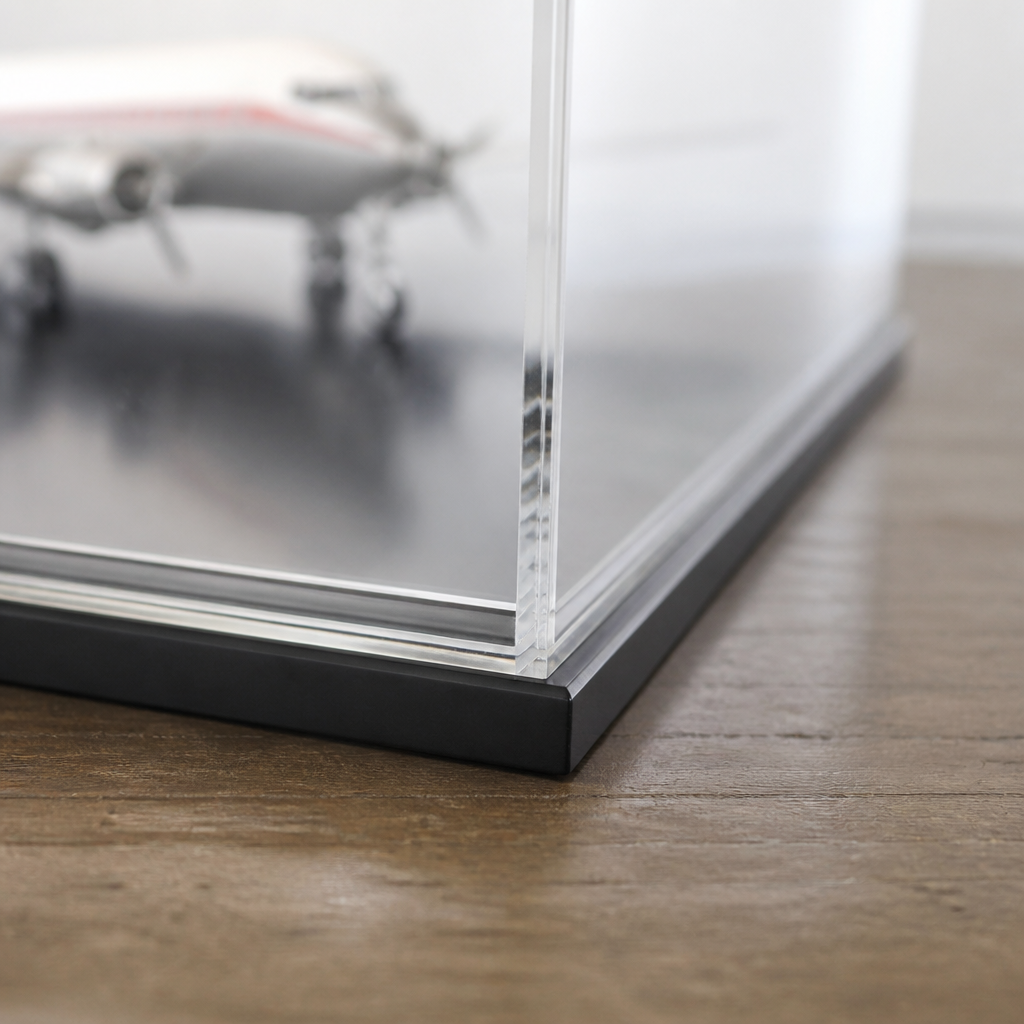
A lid that sits flat on a flat plinth leaks along its whole perimeter. What works is a rebate, a groove or a lip that overlaps, so the dust path has a corner in it. On cabinets, look for a magnetic catch that pulls the door closed against a soft seal, rather than a friction catch that leaves a hairline gap.
Room matters too. A carpeted room puts far more fibre into the air than a room with a hard floor, and a case near a door that opens onto a hallway gets more dust than the same case on an inside wall. If you have a choice of wall, this is worth two minutes of thought.
Bases and mounting
- Brass or steel rod for in-flight mounts, drilled into a strong point on the fuselage. The base must be heavy enough that the model cannot pull it over.
- Clear acrylic rod where the mount should disappear. Less strong, so it suits small scales.
- Monofilament from the case roof only for very light models, and only in a sealed case, because it swings.
- Magnets set into the base for models that get moved often. Two small magnets and a steel plate under the model hold better than any adhesive putty and leave no residue.
Light inside a case
LED strip along the top front edge, aimed down and back, gives even light without silhouetting the model. Put the driver and any wiring outside the sealed volume if you can. Avoid halogen entirely: it is hot, and a sealed case with a warm lamp inside becomes an oven that cooks decals and can soften glue joints over years. If the case feels warm to the hand after an hour, the lamp is wrong.
Cleaning without ruining the case
Ammonia-based glass cleaner crazes acrylic. The crazing is a network of fine cracks, it is permanent, and it happens on the first application. On acrylic, use a damp microfibre cloth with a drop of dish soap, or a proprietary anti-static plastic cleaner, then dry with a second clean cloth. Never dry-wipe acrylic: any dust already on the cloth becomes an abrasive. Glass takes ordinary cleaner, sprayed onto the cloth rather than onto the panel, so nothing runs down inside.
The specification to hand a cabinetmaker
Internal width equal to the largest wingspan plus twenty per cent. Internal height equal to the tallest point plus 4 cm. A rebated lid or a sealed door with a magnetic catch. LED lighting with the driver outside the case. And a base heavy enough that the whole thing cannot be knocked over by a passing sleeve.
Where to go from here
- Work out the depth before the case
Shelf depth, grouping schemes and light, measured from wingspan rather than guessed.
- Why rigged models need glass first
A rigged aircraft cannot be dusted. That single fact decides the display for the whole category.
- Storage for the models not on show
Temperature, humidity, stacking and the four conditions that decide what survives.