How to display a model aircraft collection
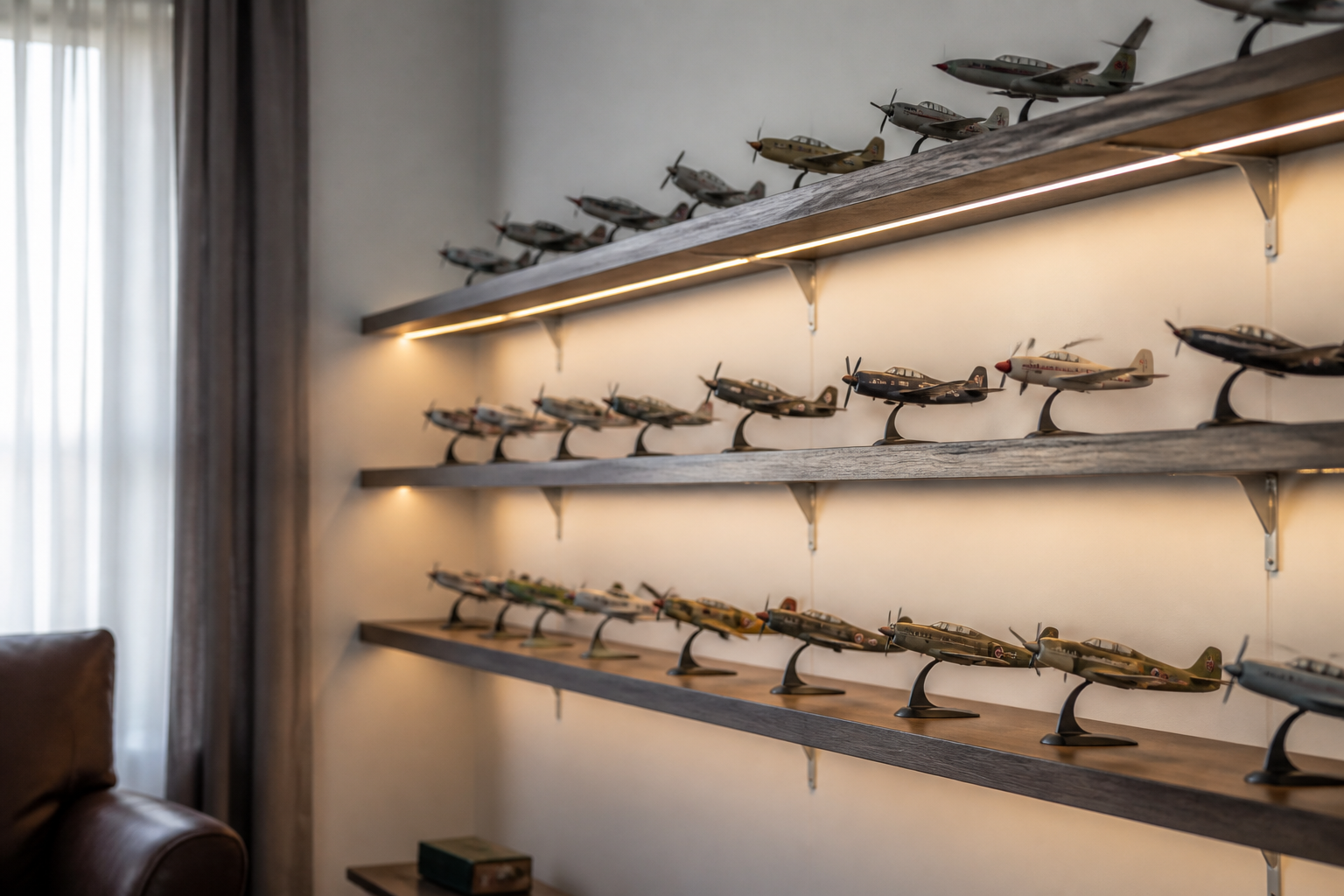
Start from the shelf, not from the model. Depth, light and dust decide what a collection looks like in five years, and all three are decided on day one.
- Last reviewed 20/08/2026
- Guide
- Open shelves and cabinets
- First measurement
- Shelf depth
- Second
- Light
- Third
- Dust
- Rule
- One scale per shelf wherever you can
Almost every display problem is a measurement problem that was solved too late. Three numbers, taken before any bracket goes on a wall, prevent most of them.
Shelf depth is the first number
For anything with a wing, the footprint is the wingspan, not the fuselage length. Take the largest span you intend to put on that shelf and add four or five centimetres so that wingtips are not overhanging the edge where sleeves catch them.
In practice that means about 20 cm of depth for 1/72 single-engine types, about 30 cm for 1/48 fighters, and about 48 cm for a 1/72 four-engine bomber, which is deeper than most bookshelves and is why those models usually end up on a low unit or a table. Helicopters follow the same rule with rotor diameter substituted for span, and the figures are in the helicopter page.
Three display modes
| Mode | What it needs | What it shows | What it costs |
|---|---|---|---|
| On its undercarriage | A flat surface and a correct ground rake | The aircraft as parked, all the top surfaces | Hides the underside completely |
| In flight, on a rod | A drilled mounting point and a base that cannot tip | The underside, gear-up lines, the attitude | Commits the model permanently to one pose |
| On a base or in a diorama | Clear space all round the model | Context, scale, a sense of place | At least doubles the footprint |
A collection reads better when it does not use all three at once on the same shelf. Two modes at most, and let the third have its own space.
Four grouping schemes that work
- By scale. The strongest scheme, because the eye then reads relative sizes correctly and the shelf tells the truth about the real aircraft.
- By era or theatre. Works when the models are close in size anyway, and gives the display a subject.
- By operator or airline. Very effective for civil subjects, where the liveries do the work.
- By finish. All natural metal together, all camouflage together. Looks deliberate rather than accidental, and it is the easiest scheme to maintain as the collection grows.
What does not work is chronology across mixed scales. The dates are invisible, so the shelf just looks unsorted.
Light, and what it does over years
Ultraviolet light is the slow enemy. It yellows and embrittles decal film, turns white paint cream, and fades reds first and fastest. Ordinary window glass blocks most UVB but passes a good deal of UVA, so a shelf that gets an hour of direct sun a day is not protected by being indoors.
Three practical rules. Keep models out of any direct sunbeam, including the one that only arrives in July. Use LED lighting, which runs cool and emits essentially no ultraviolet. Put the light above and in front, so the model is lit rather than silhouetted, and so the light does not sit inside a sealed case heating the air, which is covered in the display case guide.
Dust is the real running cost
On open shelving in a normal room, models need attention every few weeks. The tools are a soft, long-haired brush and a rubber bulb blower, worked from the top down. Never a cloth: it catches aerials and pitot tubes, and on a gloss finish the dust in the cloth acts as an abrasive. Canned air at close range snaps thin parts, so if you use it, use it from a distance.
Rigged aircraft and rigged ships cannot be dusted at all in any real sense. For those, a case is not a preference, it is the only way to keep the model.
Heights and sightlines
Whatever is at eye level is what visitors actually look at, so that is where the best model goes. Above eye level, models are seen from below, which flatters in-flight mounts and undersides. Below the waist, models are seen from above, which suits parked aircraft, ships and dioramas. A collection arranged with that in mind looks curated without anybody being able to say why.
The handling rules that prevent most damage
Hold the fuselage under the wing root. Never lift by a wingtip, a propeller, a rotor blade or an aerial. Move one model at a time, with both hands free. And put the model down before you turn around, because most breakages happen while somebody is carrying a model and reaching for a door.
When open shelving stops being the right answer
Three signs. You are dusting more often than you are building. You have models you avoid picking up. Or you have started to accept a permanent grey film on the top surfaces. Any of those means the collection has outgrown open display, and the next page is about what to replace it with.
Where to go from here
- Choose the case that fits the collection
Four case families, acrylic against glass, the sizing rule, and where dust actually gets in.
- Get the spans that set your shelf depth
Worked figures at 1/144, 1/72 and 1/48 so the depth is measured rather than guessed.
- Decide what earns a place on the shelf
Five reasons a model stays, and the three-question test for when the shelf is full.